EN
EN
 FR
FR
 DE
DE
 IT
IT
 JA
JA
 KO
KO
 RU
RU
 ES
ES
 AR
AR
 BG
BG
 HR
HR
 DA
DA
 NL
NL
 FI
FI
 EL
EL
 NO
NO
 PL
PL
 PT
PT
 RO
RO
 SV
SV
 TL
TL
 ID
ID
 SR
SR
 UK
UK
 VI
VI
 SQ
SQ
 TH
TH
 TR
TR
 AF
AF
 MS
MS
 CY
CY
 IS
IS
 HY
HY
 AZ
AZ
 KA
KA
 MN
MN
 MY
MY
 KK
KK
 UZ
UZ
 CS
CS


Releases a Medical-Grade Chest Seal: A Vented Chest Seal Engineered to Seal Open Pneumothorax and Prevent Tension Pneumothorax
Engineered to Seal Open Pneumothorax and Prevent Tension Pneumothorax
Chest seal kit, occlusive chest seal, and chest seal bandage formats now available for military, EMS, and first aid distribution channels.
[Hebei, China] — [9] [24], 2026 — Medresq today announced the commercial release of its new medical-grade chest seal, an occlusive chest seal developed for the emergency management of penetrating chest trauma. The chest seal is designed specifically for sealing an open pneumothorax and for preventing the development of tension pneumothorax. This chest seal works as a chest wound seal: when the chest wall is compromised by gunshot, stab, or blast fragment injuries, air can freely enter and exit the pleural cavity, creating an open pneumothorax, and without prompt sealing that condition may progress to tension pneumothorax — a life-threatening emergency. The new chest seal addresses that emergency directly, and the vented chest seal version adds a one-way valve that lets trapped air and blood escape during exhalation while blocking external air and contaminants from entering.
The launch covers three formats of the same chest seal platform: the standard chest seal, the vented chest seal, and the chest seal kit. Each chest seal is supplied as a sterile, single-use chest seal bandage inside a vacuum-sealed foil pouch with tear notches, and mainstream chest seal kit configurations include one to two chest seals per pack so that an entry wound and an exit wound can be treated at the same time. For procurement teams that compare chest seals medical suppliers on response time rather than unit cost, the chest seal platform is positioned as a complete chest seal first aid solution rather than a single component.
What Is a Chest Seal? A Chest Wound Seal That Closes the Chest Wall
A chest seal is an occlusive dressing — that is, an airtight chest wound seal — applied over a penetrating wound of the thorax to restore the integrity of the chest wall. The purpose of a chest seal is simple and mechanical: the chest seal blocks the pathway through which external air would otherwise enter the pleural cavity, and an effective chest seal therefore both seals an open pneumothorax and reduces the risk of tension pneumothorax. A chest seal is not a compressive bandage, and a chest seal is not a tourniquet; the chest seal is a sealing device, and the design priority of a chest seal is adhesion and occlusion rather than absorption.
The chest seal differs from a conventional gauze dressing in one decisive way. A gauze dressing lets air pass, while a chest seal does not. When a chest seal is placed over a sucking chest wound, the chest seal converts an open, air-communicating injury into a closed one, and that conversion is the entire clinical purpose of the chest seal. Emergency medical services, military medics, and wilderness rescue teams carry a chest seal as a core item of thoracic trauma equipment, and the chest seal first aid market has grown accordingly. Because the chest seal must function on skin that is wet, hairy, or contaminated, the chest seal is manufactured with a medical-grade hydrogel adhesive or a silicone gel adhesive, and both adhesive systems give the chest seal reliable attachment in adverse field conditions.
Open Pneumothorax, Sucking Chest Wound, and Tension Pneumothorax: Why a Chest Seal Is the First Response
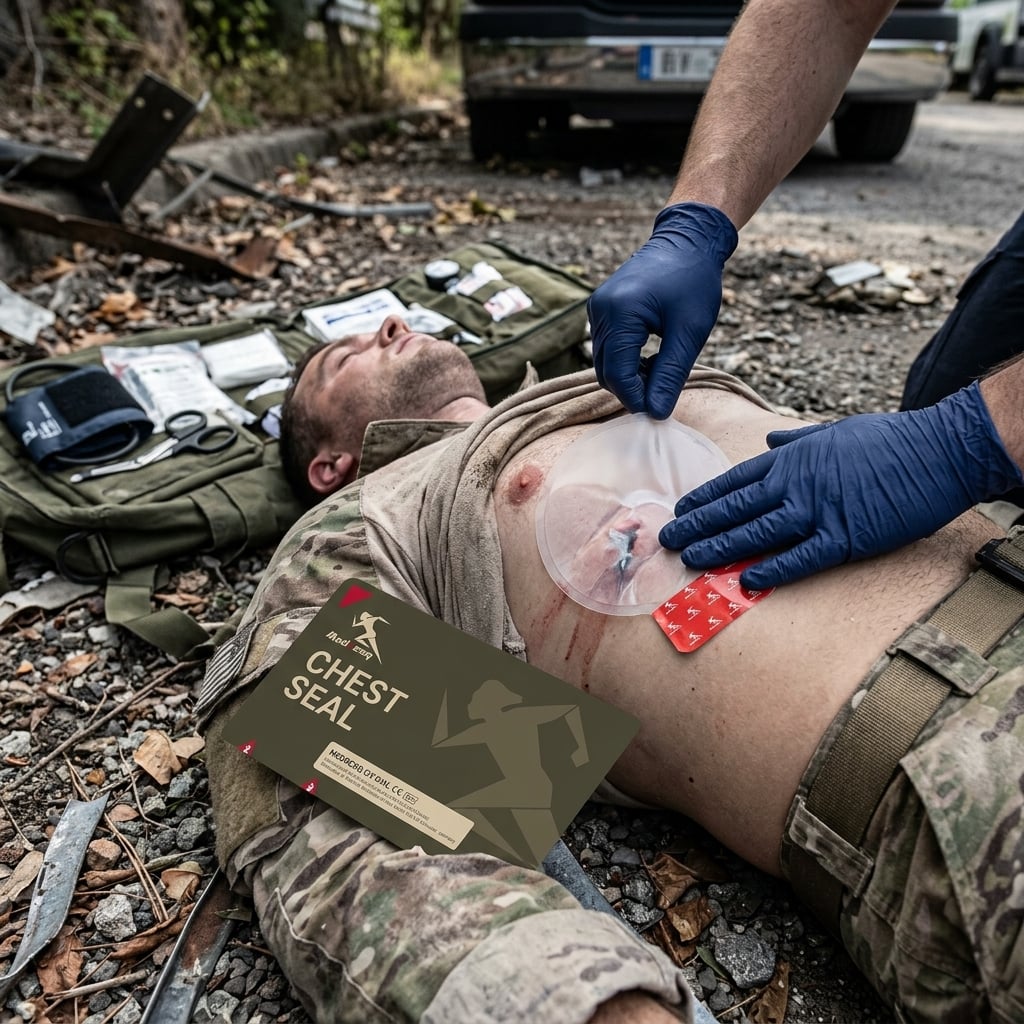
Penetrating trauma to the thorax produces a characteristic sequence that a chest seal is designed to interrupt. First, the wound breaks the chest wall, and because the chest wall no longer seals, the pleural cavity communicates freely with the outside atmosphere. That is an open pneumothorax. As the patient breathes, air moves in and out of the wound rather than in and out of the lungs, and the wound may audibly suck or bubble — the classic sucking chest wound. At this stage a chest seal provides the fastest available field intervention, since a chest seal applied to the wound immediately reduces air movement through the defect.
Second, if the defect is not sealed, or if a seal is applied incorrectly, the injury may evolve into tension pneumothorax. In a tension pneumothorax, air accumulates inside the pleural cavity under pressure while none of it can escape, the affected lung collapses, and the mediastinum is pushed toward the opposite side. This is why a vented chest seal matters. A vented chest seal carries a built-in one-way valve, and the one-way valve of the vented chest seal permits trapped air and blood to leave the pleural cavity during exhalation while preventing external air and contaminants from entering. An unvented chest seal can also be used, but an unvented chest seal requires monitoring for signs of tension pneumothorax and may require the "burping" maneuver described in the instructions for use. In short, any chest seal improves survival odds; the vented chest seal improves them while reducing the risk of the complication that most often follows thoracic trauma.
Blast injury is a third driver of chest seal demand. Explosive fragmentation frequently produces multiple penetrating wounds, so a chest seal that adheres quickly to contaminated skin is essential, and a chest seal kit that carries two seals per pack is practical. Tactical and prehospital protocols increasingly list the chest seal alongside haemostatic gauze and a decompression needle, and the chest seal has become a standard line item in individual first aid kits and tactical medic bags. On this point the evidence is consistent: the earlier a chest seal is applied, the more effectively the chest seal prevents deterioration, and a chest seal applied within the first minutes of injury is the intervention that keeps an open pneumothorax from becoming a tension pneumothorax.
Inside the Design: How the Vented Chest Seal Seals a Sucking Chest Wound
The chest seal combines three functional layers, and each layer of the chest seal contributes to the occlusion that defines the device. The backing layer of the chest seal is a medical-grade polyurethane (PU) film or a low-irritation non-woven fabric; on the transparent film version of the chest seal, the clinician can see the wound through the chest seal while positioning it, which improves placement accuracy. The adhesive layer of the chest seal is a medical-grade hydrogel or silicone gel adhesive, formulated to bond on skin covered with blood, sweat, hair, sand, or water. The third element, present only in the vented chest seal, is the one-way valve; the valve in a vented chest seal opens outward on exhalation and closes on inhalation, so the vented chest seal releases pressure without re-admitting air.
Three design features of the chest seal deserve emphasis.
Seals the wound and blocks external air — The medical-grade adhesive of the chest seal bonds firmly to the skin surrounding the wound, cutting off the pathway for external air to enter the pleural cavity. A properly applied chest seal restores a closed thoracic system, and that restored closure is what makes the chest seal therapeutic rather than merely protective.
One-way venting to prevent tension pneumothorax — The valved chest seal features a built-in one-way valve that allows trapped air and blood to escape during exhalation while preventing external air and contaminants from entering, effectively reducing the risk of tension pneumothorax. In field use, this means the chest seal continues to manage the pleural space after application instead of relying on the clinician to burp the chest seal.
Reliable adhesion under adverse conditions — Because the chest seal is formulated with a medical-grade hydrogel adhesive, it provides a superior seal even on skin covered with blood, sweat, hair, sand, or water. A chest seal that lifts at the edge stops being a chest seal; adhesion is not a secondary attribute of the chest seal, it is the defining requirement, and every chest seal in this range is validated for adhesion on contaminated skin.
The chest seal also features a transparent backing for accurate placement, a low-profile construction that prevents the chest seal from catching on clothing or equipment during transport, and a peel-off protective liner that lets a medic deploy the chest seal with gloved hands. Each chest seal is packaged for one-handed opening, because in a trauma scenario the seconds spent opening the chest seal package are clinically significant. The chest seal is designed so the seal can be placed adhesive-side down over the wound without folding, and the chest seal remains conformable over the curved surfaces of the thorax, an area where a rigid chest wound seal would fail.
How to Apply a Chest Seal: Step-by-Step Instructions for Use
Correct technique determines whether a chest seal performs as intended. The following steps apply to the standard chest seal and to the vented chest seal alike.
- Clean the wound area — Wipe blood, sweat, and debris from around the wound with sterile gauze to ensure a dry adhesion surface. A dry field around the wound helps the chest seal conform, and it reduces the chance that the chest seal will lift at the edges.
- Open the package and remove the seal — Tear open the foil pouch along the notches, take out the chest seal, and peel off the protective liner. Do not touch the adhesive face of the chest seal; handling the adhesive surface contaminates the chest seal and weakens its bond.
- Apply over the wound — Place the chest seal adhesive-side down directly over the wound, ensuring the center of the chest seal aligns with the wound site. The transparent backing of the chest seal allows for accurate placement, and the chest seal should extend well beyond the wound margins on all sides.
- Press firmly to seal — Press firmly from the center of the chest seal outward along the edges to ensure complete adhesion and an occlusive seal. The chest seal must be smoothed from the middle toward the border so that no air pocket remains trapped beneath the chest seal.
- Burp if necessary — If signs of tension pneumothorax (e.g., worsening respiratory distress) appear, lift one corner of the chest seal briefly to release trapped air, then press the chest seal back down to reseal. Users of a vented chest seal should note that the one-way valve of the vented chest seal is intended to make burping unnecessary, although the maneuver remains an available option when a chest seal is suspected of failing.
- Monitor continuously — Continuously monitor the patient's respiratory status after application of the chest seal and watch for signs of tension pneumothorax. If the chest seal loses adhesion, a second chest seal should be applied immediately, and a chest seal kit that contains two seals makes that replacement possible without delay.
- Reassess at handover — During handover the receiving clinician should be told the time the chest seal was applied and whether the chest seal is a vented chest seal or a non-vented chest seal, since that distinction changes the monitoring protocol.
Precautions and Contraindications Every Chest Seal User Should Know
Every chest seal in the range carries the following safety information, and every operator who carries a chest seal should know it before the chest seal is needed.
- The chest seal is a single-use sterile device — do not reuse or re-sterilize the chest seal.
- Do not use the chest seal with petroleum-based lubricants, because petroleum degrades the adhesive of the chest seal.
- Do not use the chest seal if the sterilization barrier or the packaging of the chest seal is compromised.
- Continuously monitor the patient's respiratory status after applying the chest seal and watch for signs of tension pneumothorax.
- The chest seal is contraindicated for individuals allergic to polyurethane film, non-woven fabric, or medical adhesives.
- Store the chest seal within its stated operating temperature range of −18°C to +55°C; the chest seal should be inspected at each kit check, and an expired chest seal should be replaced rather than retained.
- The chest seal is an adjunct, not a definitive treatment. Definitively decompressing a tension pneumothorax requires advanced intervention, and the chest seal buys time for that intervention rather than replacing it.
Applications: Where Best Chest Seals Are Deployed
The chest seal serves four primary user communities, and each community values a different attribute of the chest seal.
Military and tactical medicine. The chest seal is standard equipment in individual first aid kits, and the requirement there is a compact chest seal that can be applied under fire. A vented chest seal is generally preferred in this environment, because the vented chest seal continues to vent after the medic moves on. A chest seal kit with two chest seals supports the multi-wound pattern typical of blast trauma, and the chest seal in a chest seal kit must survive storage in an armored vehicle across a wide temperature range.
Emergency medical services and prehospital care. Paramedics carry a chest seal as part of thoracic trauma management, and the chest seal is applied during rapid extrication when lighting and conditions are poor. The transparent backing of the chest seal is a practical advantage in those circumstances, and the chest seal first aid protocol in most services now specifies a vented chest seal for penetrating thoracic wounds.
Wilderness and austere rescue. In remote settings the chest seal is often the only thoracic intervention available before evacuation, so the reliability of the chest seal is critical. Clinicians in these settings value a chest seal that adheres to wet and cold skin, and a chest seal that keeps its packaging intact through years of storage in a pack.
Civilian and occupational first aid. Range safety officers, industrial safety teams, and security professionals increasingly include a chest seal among their trauma supplies. For these users, a chest seal in a chest seal first aid kit provides a capability that no gauze dressing can substitute for, and a chest seal price advantage matters because these kits are purchased in volume.
Chest Seal Kit Options, Sizes, and Chest Seal Price Considerations for Buyers
The chest seal is offered in standard and vented configurations, and the coverage size of the chest seal ranges from approximately 13 × 13.3 cm to 15 × 15 cm. The size of the chest seal is deliberately large: the chest seal must extend beyond the wound margins on all sides to create a sealing lip, and a chest seal that is too small cannot occlude a ragged blast wound. Mainstream chest seal products typically include one to two chest seals per pack to allow simultaneous treatment of entry and exit wounds.
Buyers evaluating chest seals medical suppliers should weigh four variables. First, valve type — a vented chest seal versus a non-vented chest seal changes the monitoring burden and the clinical risk profile, and the vented chest seal is the safer default for prehospital use. Second, adhesive chemistry — a hydrogel chest seal typically performs better on wet or bloody skin than a basic acrylic chest seal, and the adhesive is the most common point of failure in any chest seal. Third, packaging durability — a chest seal must survive vacuum-seal integrity checks, and a chest seal whose foil pouch has failed is no longer sterile. Fourth, total kit economics — the chest seal price in isolation is less meaningful than the cost per treated casualty, and a chest seal price that looks high is often the price of a chest seal kit that includes two seals per pouch.
For distributors and procurement officers, the chest seal is a consumable, which means chest seal demand is driven by training cycles as well as deployments. Every training iteration consumes a chest seal, so a supplier's ability to deliver the chest seal in consistent batches matters as much as the initial chest seal price. Requesting samples of the chest seal before a tender, verifying the sterilization method recorded on the chest seal label, and confirming that the same chest seal specification is used across all SKUs in the chest seal kit range are the three practical steps that reduce procurement risk.
Keyword and Product Reference: Chest Seal Variants at a Glance
The following reference summarizes the chest seal terminology used across the range.
|
Keyword |
Meaning |
|
chest seal |
The core occlusive dressing for penetrating chest trauma |
|
chest seal vented |
A chest seal with a built-in one-way valve; also written as vented chest seal |
|
chest seal kit |
A packaged set containing one to two chest seals, often with accessories |
|
chest seal bandage |
A common synonym for the chest seal when used as a dressing |
|
chest seals medical |
Medical-grade chest seals intended for professional use |
|
occlusive chest seal |
A chest seal defined by its airtight sealing function |
|
chest wound seal |
A general term for any seal applied to a chest wound |
|
chest seal first aid |
Use of the chest seal as a first aid intervention |
|
best chest seals |
Comparative shorthand used by buyers evaluating chest seals medical products |
|
chest seal price |
Unit or kit pricing for the chest seal |
Frequently Asked Questions About the Chest Seal
What is a chest seal used for?
A chest seal is used to seal a penetrating wound of the chest so that an open pneumothorax is closed and the progression to tension pneumothorax is prevented. The chest seal is applied over the wound, and the chest seal remains in place during evacuation.
Is a vented chest seal better than a non-vented chest seal?
A vented chest seal is generally preferred for prehospital use, because the one-way valve in a vented chest seal lets trapped air escape during exhalation. A non-vented chest seal can still be effective, but a non-vented chest seal requires closer monitoring and may need to be burped.
How many chest seals are in a chest seal kit?
A typical chest seal kit contains one to two chest seals, and a chest seal kit with two seals allows both an entry wound and an exit wound to be covered with the same chest seal kit.
Can a chest seal be reused?
No. The chest seal is a single-use, sterile device, and a chest seal must never be reused or re-sterilized. Once a chest seal is opened, the chest seal should be used or discarded.
What is the shelf life of the chest seal?
The chest seal should be stored in its unopened foil pouch within −18°C to +55°C, and each chest seal should be inspected during kit checks. Replace any chest seal whose packaging is compromised.
Does the chest seal work on wet or bloody skin?
Yes. This chest seal uses a medical-grade hydrogel or silicone gel adhesive that is formulated for skin covered with blood, sweat, hair, sand, or water. Adhesion of the chest seal on contaminated skin is the design target, not an exception.
How is the chest seal sterilized?
The chest seal is sterilized by ethylene oxide (EO) or by irradiation, and the chest seal is supplied sterile for single use. The sterilization method is stated on the chest seal packaging.
What should I check when comparing best chest seals for purchase?
Compare the valve type of each chest seal, the adhesive chemistry of each chest seal, the coverage size of each chest seal, the sterilization method, and the chest seal price per seal rather than per kit.
Chest Seal Selection Matrix: Matching the Chest Seal to the Mission
Selecting the right chest seal is a mission-matching exercise, and the table below maps the chest seal variant to the operating environment in which each chest seal performs best.
|
Operational scenario |
Recommended chest seal |
Why this chest seal fits |
|
Tactical care under fire |
Vented chest seal |
The vented chest seal keeps venting after the medic breaks contact; a non-vented chest seal needs burping by hand. |
|
Prolonged field care |
Vented chest seal |
A vented chest seal manages the pleural space for hours; a plain chest seal requires repeated reassessment of the chest seal. |
|
Rapid extrication at night |
Transparent-backing chest seal |
The transparent chest seal lets the medic position the chest seal over the wound without removing the chest seal. |
|
Blast fragmentation with entry and exit wounds |
Chest seal kit |
A chest seal kit carries two chest seals, so one chest seal kit covers both a chest wound seal at entry and a chest wound seal at exit. |
|
Wet, cold, or sand-contaminated skin |
Hydrogel chest seal |
The hydrogel chest seal adheres to wet skin where a basic chest seal would lift. |
|
Classroom and refresher training |
Low-cost chest seal |
A training chest seal is consumed every drill, so the chest seal price per unit drives training budget. |
|
Civilian range and industrial first aid |
Chest seal first aid pack |
A compact chest seal first aid pack keeps the chest seal accessible in a wall-mounted trauma station. |
|
Mass-casualty stockpile |
Chest seal kit, bulk |
Bulk chest seal procurement lowers the chest seal price per seal and standardizes one chest seal specification. |
Chest Seal Kit Check and Storage Protocol
The following chest seal checks should be performed at every kit inspection, because an inspected chest seal is a functioning chest seal and an uninspected chest seal is an unknown quantity.
- Confirm the chest seal pouch is vacuum-sealed, because a loose chest seal pouch means the chest seal is no longer sterile.
- Confirm the sterilization indicator on the chest seal packaging, because an unverified chest seal must not be used on a patient.
- Confirm the expiry date of the chest seal, and rotate the older chest seal to the front of the kit.
- Confirm the chest seal has not been stored outside −18°C to +55°C, since heat cycling degrades the adhesive of the chest seal.
- Confirm the chest seal count in the chest seal kit matches the inventory, because a missing chest seal is discovered only when the chest seal is needed.
- Confirm the chest seal is a vented chest seal where the protocol requires a vented chest seal, and mark the chest seal kit accordingly.
- Confirm the operator has practiced applying the chest seal within the last training cycle, because hands-on chest seal practice is what makes the chest seal application automatic.
- Confirm the chest seal is stored with sterile gauze, since the chest seal should be applied to a wiped field around the chest wound seal.
Chest Seal Positioning Notes for Difficult Wounds
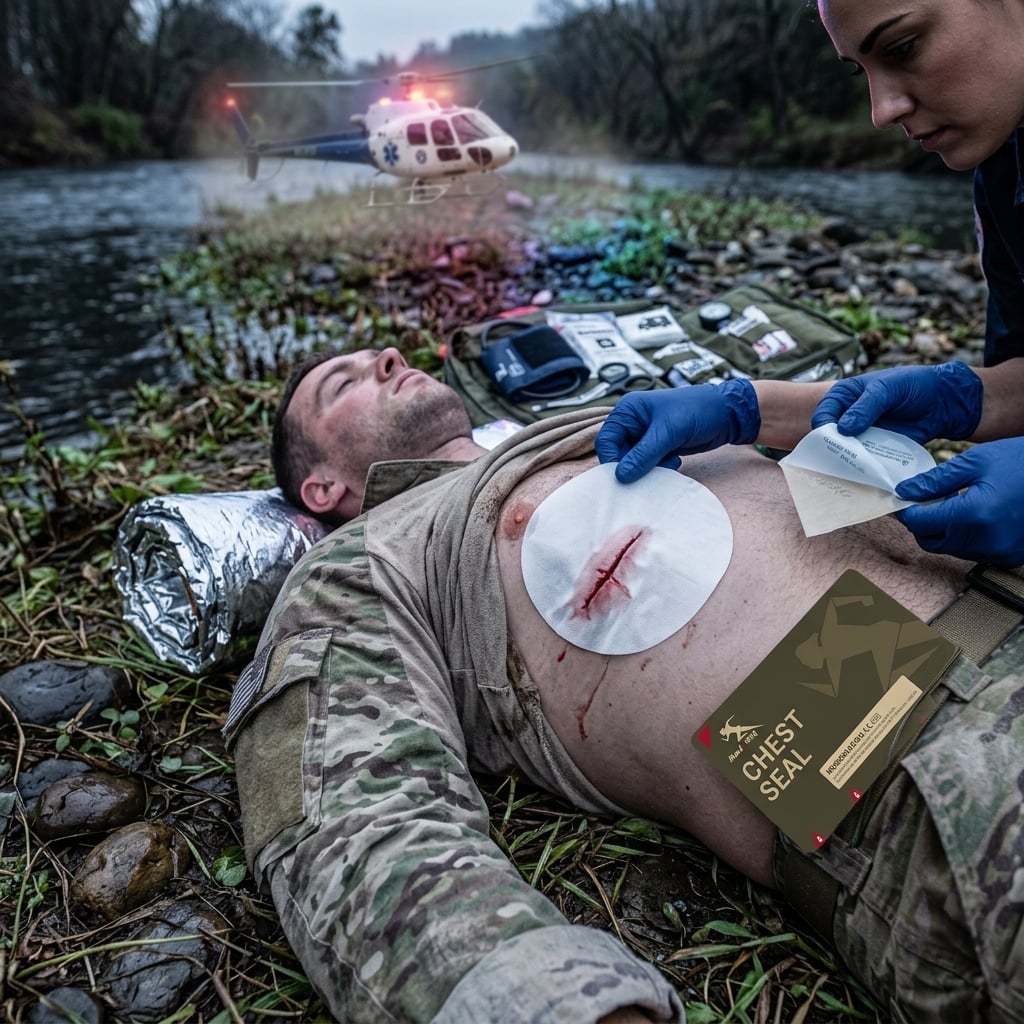
Positioning a chest seal on a curved or irregular wound demands care, and the notes below apply to every chest seal in the range. A chest seal placed on the apex of the axilla must be smoothed along the chest seal border so that the chest seal does not peel. A chest seal applied over a clavicle must be reinforced at the edge where the chest seal crosses the bone, because the skin moves beneath the chest seal. When two chest seals are required, the second chest seal should be placed so that the two chest seal borders overlap rather than abut, which prevents a gap from forming between the chest seal and the chest seal. If a chest seal is applied over a dressing, that chest seal will not occlude, and such a chest seal should be removed and replaced with a chest seal placed directly on the skin. A chest seal that has been rolled in a pocket and unfolded will not lie flat, so a chest seal carried in a flat pouch is preferable when the chest seal is expected to be used in a hurry. Finally, a chest seal is the intervention that precedes decompression; a chest seal is not a substitute for decompression, and a chest seal should never delay it.
Chest Seal Terminology Index for Buyers and Distributors
Every chest seal specification sheet uses the same words in slightly different ways, and this chest seal index defines each chest seal term as it is used across the chest seal range.
|
Chest seal term |
How the chest seal buyer should read it |
|
chest seal |
The core chest seal: an occlusive chest seal for a penetrating chest wound; every other chest seal variant builds on this chest seal. |
|
chest seal vented |
A chest seal with a one-way valve; the vented chest seal vents trapped air so the chest seal keeps sealing, and the chest seal does not need manual burping. |
|
chest seal kit |
A chest seal kit is a packaged chest seal set with one or two chest seals, so a chest seal kit can cover an entry chest seal and an exit chest seal. |
|
chest seal bandage |
A chest seal bandage is the same chest seal described as a dressing; a chest seal bandage is an occlusive chest seal, not an absorbent chest seal. |
|
chest seals medical |
Chest seals medical refers to chest seals built to medical device standards, and each chest seal of this type is a sterile single-use chest seal. |
|
occlusive chest seal |
An occlusive chest seal is a chest seal whose function is airtight closure; the chest seal occludes the chest wound seal completely. |
|
chest wound seal |
A chest wound seal is the generic name for a chest seal applied to a chest wound; a chest wound seal and a chest seal are the same chest seal. |
|
chest seal first aid |
Chest seal first aid is the use of a chest seal in the first minutes; a chest seal first aid kit carries a chest seal where the chest seal is needed first. |
|
best chest seals |
Best chest seals is comparative shorthand; the best chest seal is the chest seal that adheres and vents for the chest seal application at hand. |
|
chest seal price |
Chest seal price should always be read per chest seal, not per carton, since a chest seal kit with two chest seals changes the chest seal price per wound. |
|
vented chest seal vs non-vented chest seal |
A vented chest seal vents automatically while a non-vented chest seal must be monitored, so the chest seal choice changes the chest seal protocol. |
|
chest seal adhesive |
The chest seal adhesive decides whether the chest seal holds; a hydrogel chest seal outperforms a basic chest seal on bloody or wet skin. |
|
chest seal size |
Chest seal size must exceed the wound, because a chest seal that is too small cannot create a sealing lip when the chest seal is pressed down. |
|
chest seal sterilization |
Chest seal sterilization is performed by ethylene oxide or irradiation, and a chest seal whose pouch is breached is no longer a sterile chest seal. |
|
chest seal packaging |
Chest seal packaging is a vacuum-sealed foil pouch with tear notches, which lets the chest seal be opened with one hand. |
|
chest seal shelf life |
Chest seal shelf life depends on storage, and a chest seal stored within −18°C to +55°C keeps its chest seal adhesive intact. |
|
chest seal training |
Chest seal training consumes a chest seal per drill, so a reusable trainer chest seal lowers chest seal training cost. |
|
chest seal certification |
Chest seal certification documents the chest seal standard, and a certified chest seal should be requested before any chest seal tender. |
|
chest seal supplier |
The chest seal supplier must provide the chest seal specification, the chest seal sterilization record, and the chest seal batch traceability. |
|
chest seal MOQ |
Chest seal MOQ governs the chest seal price curve, so a distributor planning chest seal volume should agree the chest seal MOQ early. |
|
chest seal OEM |
Chest seal OEM lets a distributor brand the chest seal, and a private-label chest seal keeps the chest seal artwork on the chest seal pouch. |
|
chest seal application |
Correct chest seal application means pressing the chest seal from its center outward so the chest seal seals with no trapped air. |
|
chest seal removal |
Chest seal removal should be deliberate, and a chest seal should be replaced the moment the chest seal loses adhesion. |
|
chest seal burping |
Chest seal burping lifts a chest seal corner to release air; a vented chest seal is designed to make chest seal burping unnecessary. |
|
chest seal monitoring |
Chest seal monitoring means watching the chest seal and the patient, since a chest seal that lifts is no longer a working chest seal. |
|
chest seal compliance |
Chest seal compliance means the chest seal meets the buyer's protocol, so the chest seal must match the chest seal specification exactly. |
|
chest seal documentation |
Chest seal documentation should accompany every chest seal shipment and record the chest seal batch and the chest seal sterilization date. |
|
chest seal warranty |
Chest seal warranty covers the chest seal quality claim, and a chest seal replaced under warranty keeps the same chest seal specification. |
Chest Seal Competency Checklist for Operators
- Recite when a chest seal is indicated, and state why a chest seal is applied before a chest seal is opened.
- Open the chest seal pouch by the notches, and confirm the chest seal liner is intact before the chest seal touches the patient.
- Place the chest seal adhesive-side down, and confirm the chest seal center sits over the wound, not beside the chest seal.
- Smooth the chest seal from its center outward, and check the chest seal border for a lifted chest seal edge.
- Decide whether the chest seal is a vented chest seal, and document on the chest seal record which chest seal was used.
- Watch the chest seal during transport, and replace the chest seal if the chest seal stops adhering.
- Know when to burp a chest seal, and understand that a vented chest seal rarely requires the chest seal to be burped.
- Hand over the chest seal time and chest seal type, so the next clinician inherits a documented chest seal, not an unknown chest seal.
- Restock the chest seal kit after use, and verify the replacement chest seal is the same chest seal specification.
- Retrain on the chest seal each cycle, because a chest seal skill decays quickly and a stale chest seal habit fails under stress.
About Medresq
Medresq manufactures medical-grade trauma and first aid products, including the chest seal platform described in this release. The chest seal range of Medresq is produced under a documented quality system, and every chest seal batch is released with traceable sterilization records. Medresq supplies the chest seal, the vented chest seal, and the chest seal kit to distributors, EMS organizations, and institutional buyers, and the company supports tender requirements for the chest seal with technical documentation, samples, and customization of the chest seal kit configuration.
Media contact: [Claire Zhao] | [ [email protected] ] | [ +86 178 2229 5061] | [ Medresq Website]
Product line: chest seal | chest seal vented | chest seal kit | chest seal bandage | occlusive chest seal | chest wound seal | chest seal first aid | best chest seals | chest seal price
Hot News
-
Bag Valve Mask (BVM): The Complete Professional Guide to Manual Resuscitation and Emergency Ventilation
2026-09-24
-
Releases a Medical-Grade Chest Seal: A Vented Chest Seal Engineered to Seal Open Pneumothorax and Prevent Tension Pneumothorax
2026-09-24
-
Why Your Rescue Team Needs a Carbon Fiber Scoop Stretcher
2026-06-05
-
How to Choose a Reliable Vented Chest Seal for Pre-Hospital Trauma Care
2026-06-04
-
Essential Cervical Spine Immobilization for Emergency Care
2026-03-05
-
Medical Oropharyngeal Airway: Essential Airway Management Device for Emergency Care
2026-03-04
-
Beyond the Battlefield: Versatile Applications of Modern Tactical First Aid Kits
2026-01-27
-
Advancements in Medical Structures: Enhancing Emergency Response and Patient Care
2025-06-13
-
The Vital Role of Stretchers in Emergency Medical Care
2025-03-07
-
DEVELOPMENT AND PROSPECT OF BATTLEFIELD INDIVIDUAL FIRST AID KIT
2025-02-20